
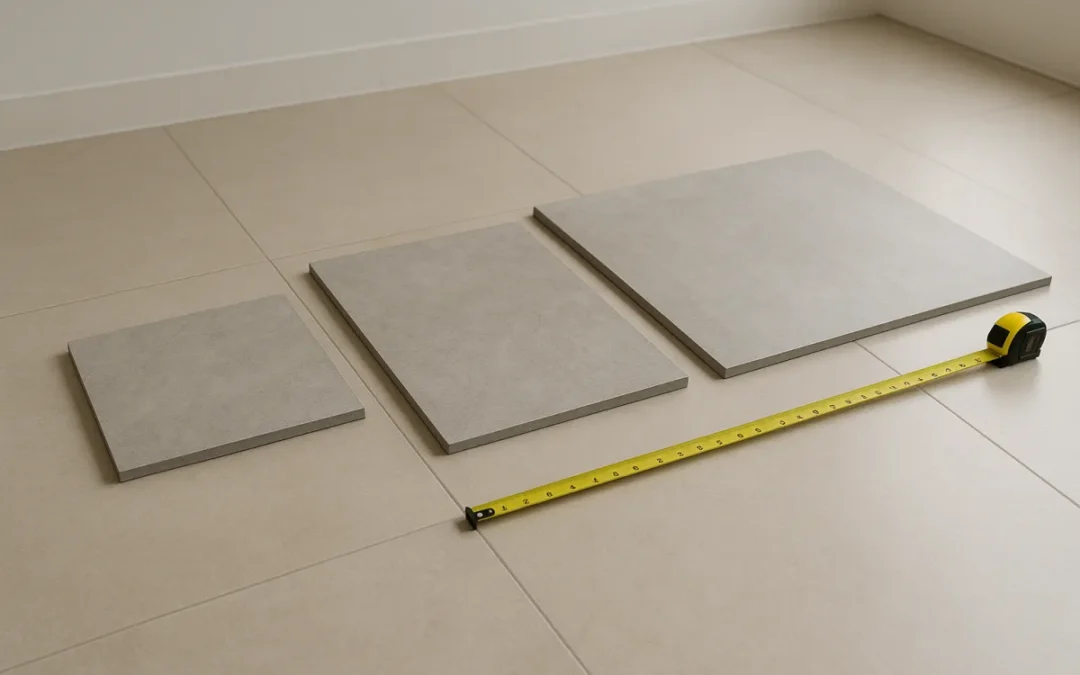
Tile sizes have quietly grown. Twenty years ago a Malaysian living room floor was 300 x 300 mm or 400 x 400 mm. Today 600 x 600 mm is the ordinary choice and 600 x 1200 mm is common. The right size for a room depends on the room, the look you want, the flatness of the floor and, honestly, the budget for cutting and laying.
This guide lists the sizes you will actually find in a Malaysian showroom, what each one is for, and how the choice affects grout lines, wastage and cost.
The common sizes and what they are for
300 x 300 mm
The traditional small floor tile. Still used for bathroom floors, where the many grout lines add grip and the small size copes with the slope to the floor trap, and for wet kitchens, yards and outdoor areas. Easy to lay on an uneven surface.
300 x 600 mm
The most common wall tile size in Malaysia. Laid horizontally it widens a bathroom; laid vertically it makes the ceiling feel higher. Also used on floors in small rooms and corridors.
400 x 400 mm and 500 x 500 mm
Older mid sizes, now less common. Sometimes chosen for a budget floor where 600 x 600 mm would need more cutting.
600 x 600 mm
The standard floor tile for living rooms, dining rooms, bedrooms, corridors and shops. Big enough to reduce grout lines, small enough to lay and cut easily and to replace one later. If you are not sure, this is the size.
600 x 1200 mm
The modern large format. Long rectangles that stretch a room visually and cut the number of joints in half compared with 600 x 600 mm. Needs a flat floor, a C2 S1 adhesive with back-buttering, and a tiler who lays large formats regularly.
800 x 800 mm and 1200 x 1200 mm
Large squares for big open-plan spaces, lobbies and showrooms. Impressive in a large room, oversized in a small one, and heavy to handle.
Slabs (1200 x 2400 mm and up)
Porcelain slabs used for feature walls, countertops and very large floors with almost no joints. Specialist handling and installation; not a normal home-floor choice.
Mosaics and small formats
Sheets of small pieces for shower floors, niches, feature strips and curves.
How size changes the room
- Fewer grout lines make a room look bigger. That is the main reason large formats are popular. A 600 x 1200 mm floor with thin, colour-matched joints reads almost as one surface.
- Small tiles in a large room look busy; large tiles in a small room can look out of scale, though a single large format in a small bathroom often works better than expected because there are so few joints.
- Direction matters for rectangles. Lay them along the room’s length or toward the window to draw the eye through.
- Proportion to the room. If a room needs more than a few cut tiles at each wall, a different size may fit with less waste. Sketch the layout before ordering.
How size changes the job
Floor flatness
The bigger the tile, the flatter the floor has to be. A 300 x 300 mm tile follows small dips; a 600 x 1200 mm tile bridges them and rocks, or sits with a void underneath that later cracks. Large formats often need a levelling screed first, which is a real cost to include.
Laying and cutting
Large porcelain is heavy and hard. Laying it needs two people, a large-notch trowel, back-buttering and a levelling clip system to control lippage (one edge sitting higher than its neighbour). Cutting needs a proper wet saw. Labour rates for large formats are higher for good reason.
Wastage
Every cut tile at the edge of a room wastes the offcut, and a large tile wastes a larger offcut. Plan for about 10% extra for a straight layout of 600 x 600 mm, 12 to 15% for large rectangles and for diagonal or herringbone layouts, and more in a room with many corners. Our tile calculator works out the quantity from the room’s measurements and the tile size.
Cost
Per square metre, tile prices vary more by type and finish than by size, but the total job cost rises with size because of the flatter substrate, the adhesive, the labour and the wastage. A 600 x 600 mm floor is usually the most economical complete job; that is why it is the standard.
Size by room
- Living and dining: 600 x 600 mm or 600 x 1200 mm. Run the same tile through into the corridor. See our living room floor tiles guide.
- Bedrooms: 600 x 600 mm, or wood-look planks (typically 150 to 200 mm wide by 900 to 1200 mm long).
- Bathroom floor: 300 x 300 mm or 300 x 600 mm for grip and for the fall to the drain; 600 x 600 mm in a larger, flat bathroom with a linear drain. Always a slip-resistant finish.
- Bathroom walls: 300 x 600 mm, or 600 x 1200 mm for a seamless look. See our bathroom tiles page.
- Kitchen floor: 600 x 600 mm; wet kitchen 300 x 300 mm or 300 x 600 mm in a matt anti-slip finish. See kitchen tiles.
- Kitchen backsplash: 300 x 600 mm, or a large-format slab for a joint-free look.
- Car porch and outdoor: 300 x 300 mm to 600 x 600 mm in a textured outdoor tile; larger formats outdoors need excellent falls and full adhesive coverage. Our outdoor tiles guide has more.
- Shops and offices: 600 x 600 mm homogeneous. Easy to replace one tile later.
Rectified or not?
A rectified tile has its edges ground after firing so every tile is exactly the same size and the edge is square. That allows a very thin joint (1.5 to 2 mm), which is what makes large-format floors look seamless. A non-rectified tile has the small size variation of the kiln and needs a wider joint (3 mm or more) to hide it. Check which you are buying, because the joint width changes the look completely. The grout colour matters just as much; our grout guide covers it.
A note on nominal sizes
A “600 x 600 mm” tile is usually a few millimetres smaller than 600 mm, so that the tile plus its joint lays out to a round module. Measure a real tile before you plan a layout to the millimetre, and use the calculator with the actual size where it matters.
See sizes side by side on our floor tiles page, and read our installation guide for how the laying changes with size.
Enter your room measurements and the tile size in our calculator to see how many tiles you need, then check the size at full scale in our Sungai Buloh showroom before you order.
Frequently asked questions
What is the most common floor tile size in Malaysia?
600 x 600 mm for living areas and bedrooms, 300 x 600 mm for walls, and 300 x 300 mm for bathroom and wet-area floors.
Do bigger tiles make a room look bigger?
Generally yes, because there are fewer grout lines breaking up the surface. Thin, colour-matched joints strengthen the effect.
How much extra tile should I buy?
About 10% for a straight layout, 12 to 15% for large rectangles, diagonal or herringbone patterns, and more for rooms with many corners.
Are large tiles harder to install?
Yes. They need a flatter floor, a deformable adhesive with back-buttering, two people to handle them and a levelling system to control lippage. Labour costs more.
What does rectified mean?
The tile’s edges have been ground square and to an exact size after firing, so it can be laid with a very thin joint.