
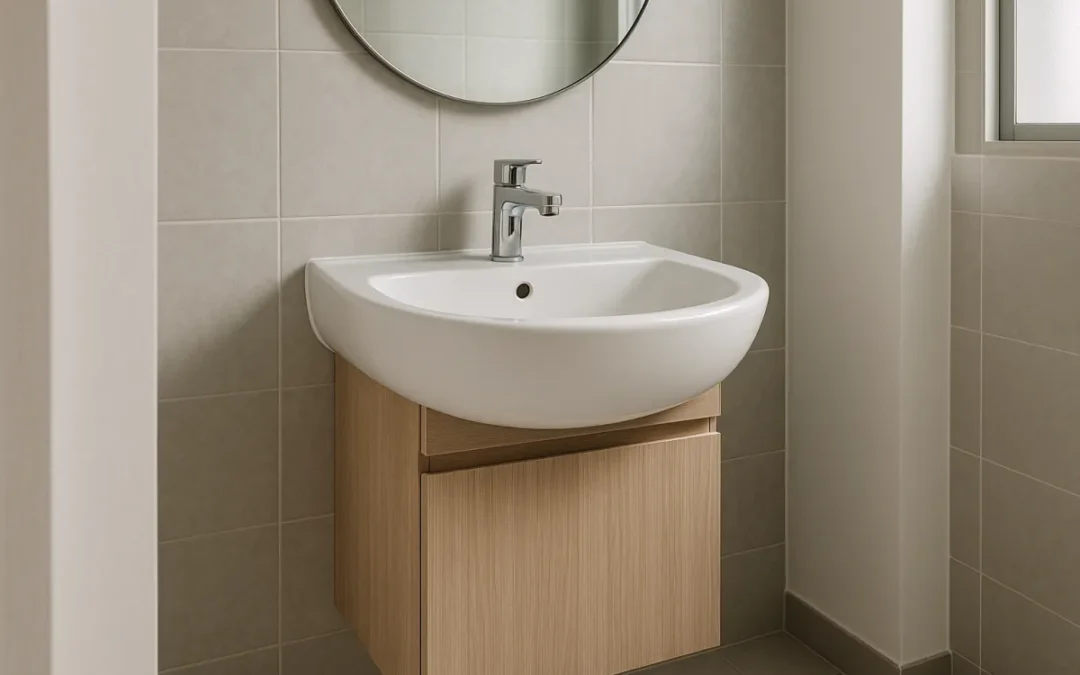
A basin looks like a simple choice until you stand in a showroom and find five different ways to mount one. Each one changes the cabinet you need, the tap you need, the plumbing behind the wall and how much floor space is left. Choose by looks alone and you can end up with a beautiful basin that does not fit the vanity, or a tap too short to reach the bowl.
This guide explains the five basin types, what each one needs, and which one suits the kind of bathroom you have.
The five basin types
1. Semi-recessed basin
A semi-recessed basin sits partly inside the countertop and partly in front of it, so the front of the bowl projects beyond the cabinet. It was designed to solve one problem: shallow cabinets. A full-depth vanity needs 50 to 60 cm of floor; a semi-recessed basin lets the cabinet be as slim as 30 to 40 cm while the bowl still has a proper size.
- Best for: narrow bathrooms and en-suites where a full-depth vanity would block the door or the toilet.
- Needs: a countertop or cabinet cut to the basin’s template, and a standard basin tap mounted on the deck behind the bowl or on the basin itself if it has a tap hole.
- Watch for: the projecting front edge; at the right height it is comfortable, too low and it catches your thighs.
Browse our semi-recessed basins.
2. Wall-hung basin
A wall-hung basin is fixed directly to the wall with no cabinet or pedestal beneath it. The floor stays clear, which makes a small bathroom feel bigger and makes mopping easy.
- Best for: compact bathrooms, guest toilets, and anyone who wants a clean minimal look.
- Needs: a solid wall (brick or concrete) or a proper backing frame in a partition wall, because the whole weight, plus anyone who leans on it, hangs on the fixings. The waste pipe is visible unless a bottle trap in a matching finish is used.
- Watch for: no storage. Pair it with a mirror cabinet or a wall shelf if you need somewhere for toiletries.
Browse our wall-hung basins.
3. Counter-top (vessel) basin
A counter-top basin sits on top of the vanity like a bowl. It is the most decorative option, available in round, oval and rectangular shapes and in ceramic, stone and glass.
- Best for: master bathrooms and anywhere the basin is meant to be a feature.
- Needs: a tall basin tap or a wall-mounted tap, because a standard tap will not clear the rim. This is the single most common mistake with vessel basins. The countertop must also be lower than usual so the rim of the bowl ends up at a comfortable height, around 85 to 90 cm.
- Watch for: splashing if the tap is set too high above the bowl, and cleaning around the base of the bowl where it meets the counter.
4. Under-counter basin
An under-counter basin is fitted from below, so the countertop runs cleanly over its edge. It gives the sleekest look and the easiest countertop to wipe, because there is no rim to catch water.
- Best for: solid-surface or stone countertops, and households that value easy cleaning.
- Needs: a countertop material that can be cut and finished with a clean edge (stone, quartz or solid surface, not laminate), and a fabricator to do the cut-out. The tap mounts on the countertop.
5. Pedestal and half-pedestal basin
The traditional freestanding basin on a ceramic column that hides the pipework. A half-pedestal is the same idea with a shorter column fixed to the wall, leaving the floor clear.
- Best for: simple bathrooms and budget renovations where no cabinet is planned.
- Needs: very little. Standard tap, standard waste. The pedestal hides the trap.
- Watch for: no storage and no countertop space at all.
Which basin for which bathroom?
- Small bathroom, door or toilet close to the basin wall: semi-recessed on a slim cabinet, or wall-hung.
- Guest toilet or powder room: wall-hung or a small counter-top bowl on a floating shelf.
- Family bathroom that needs storage: semi-recessed or under-counter on a full basin cabinet.
- Master bathroom with a stone counter: under-counter for a clean look, or counter-top for a feature.
- Two people in the morning: a double under-counter or two counter-top bowls on one long vanity.
Height, tap and plumbing: the three things to settle before you buy
Height
The rim of the basin should end up at about 85 to 90 cm from the floor for adults. For a counter-top bowl that means a lower cabinet; for a wall-hung basin it means marking the wall carefully before the tiler starts.
Tap
Each basin type has a tap that suits it. A deck-mounted basin tap for semi-recessed, under-counter and pedestal basins; a tall tap or a wall-mounted tap for a counter-top bowl; either for a wall-hung basin depending on whether it has a tap hole. Check the number of tap holes on the basin (one, or none for a wall-mounted tap) before you choose. See our basin taps.
Plumbing
A wall-hung basin and a wall-mounted tap both need the pipes brought to exact positions inside the wall before tiling. Decide the basin and tap first, give the plumber the templates, then tile. Doing it the other way round means chasing into finished tiles.
Materials and cleaning
Vitreous china (glazed ceramic) is the standard basin material: hard, non-porous, easy to wipe and available in every shape. Stone and solid-surface basins look striking but need more care against staining. Whatever the material, a basin with gentle curves and no tight corners is easier to keep clean than one with sharp internal angles. Match the finish of the tap and waste to the other fittings in the room; our bathroom accessories checklist covers finishing the set.
See the full basin range and the bathroom tiles they sit against.
Tell us the width of your basin wall and whether you want a cabinet, and we will suggest the basin type, the cabinet and the right tap for it. Or see them fitted at our Sungai Buloh showroom.
Frequently asked questions
What is a semi-recessed basin?
A basin that sits partly inside the countertop and partly in front of it, so the bowl projects beyond a slim cabinet. It gives a full-size bowl on a cabinet as shallow as 30 to 40 cm.
Which basin is best for a small bathroom?
A wall-hung basin, which keeps the floor clear, or a semi-recessed basin on a slim cabinet if you need storage.
Do counter-top basins need a special tap?
Yes. A tall basin tap or a wall-mounted tap, because a standard tap will not reach over the rim of the bowl.
Can a wall-hung basin go on a partition wall?
Only with a proper backing frame or support bracket fitted inside the wall before it is closed and tiled. On its own, plasterboard will not carry the load.
How high should a bathroom basin be?
The rim should sit at about 85 to 90 cm from the floor for adults.