
For decades, tiles in Malaysia were laid on a bed of sand and cement mixed on site. Many still are. It works for a small ceramic tile on a dry floor, and it is cheap. But the tiles we lay today are different: dense porcelain that absorbs almost no water, formats of 600 x 1200 mm and larger, and tiles going into showers, wet kitchens and car porches. On those, a cement bed is the reason a tile sounds hollow after a year and lifts after three.
This guide explains what tile adhesive is, when it is essential, how to read the codes on the bag, and what to use where.
Sand-cement mortar: what it is and where it still works
Traditional tiling uses a thick bed (often 20 to 40 mm) of sand and cement, sometimes with a slurry of neat cement on the back of the tile to help it grip. It gives the tiler a lot of room to level an uneven floor, which is why it survives.
Its weakness is bond. Cement grips a tile by soaking into the tile’s back and hardening there. A porous ceramic tile allows that. A porcelain tile, with water absorption under 0.5%, does not: the cement has nothing to soak into, so the bond is weak and brittle. Add the shrinkage of a thick cement bed as it dries and you get hollow spots, then cracks, then loose tiles.
Sand-cement is still acceptable for small ceramic tiles in dry indoor areas where the floor needs heavy levelling. For everything else, use an adhesive.
Tile adhesive: what it is
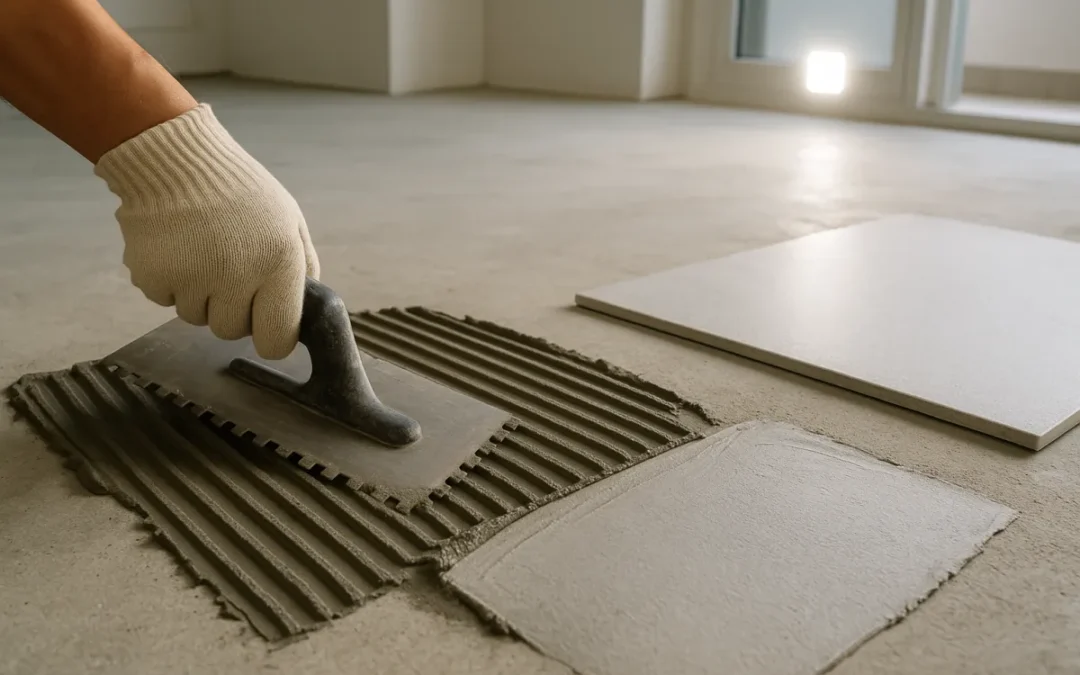
A cementitious tile adhesive is a factory-blended powder of cement, graded sand and polymer additives, mixed with water on site and spread thinly (3 to 10 mm) with a notched trowel. The polymers do the work the cement cannot: they bond to non-porous surfaces, stay slightly flexible, and hold water in the mix so it cures properly instead of drying out too fast under a dense tile.
The result is a stronger, thinner, more even bed with far fewer hollow spots. It costs more per bag than cement, but it uses far less material, so the difference on a whole floor is smaller than people expect, and it is a fraction of the cost of relaying a failed floor.
Reading the bag: C1, C2, S1, S2
Most adhesives sold in Malaysia are classified to the European standard EN 12004, and the codes tell you what the product can do.
- C1: a standard cementitious adhesive. Fine for ceramic tiles on walls and dry floors.
- C2: improved adhesion. This is the minimum for porcelain and homogeneous tiles, and for any tile in a wet area.
- S1: deformable. The adhesive can flex a little, which is what you want under large-format tiles, on floors that see temperature swings such as car porches and balconies, and over substrates that move slightly.
- S2: highly deformable. For the most demanding cases: very large slabs, timber substrates, exterior facades.
- Extra letters: T means reduced slip (the tile does not slide down a wall while setting), E means extended open time (more working time in our heat), F means fast setting.
So a bag marked C2TE S1 is an improved adhesive, non-slip on walls, with a long open time and some flexibility. That is a sensible all-round choice for porcelain in a Malaysian home.
What to use where
Porcelain and homogeneous tiles
C2 as a minimum, always. This includes almost every floor tile sold today. See our tile types guide if you are not sure which you have.
Large-format tiles (600 x 1200 mm and up)
C2 S1, applied to both the floor and the back of the tile (back-buttering) so there are no voids under the tile. A void under a large tile is where it will crack when a heavy load lands on it. Use a large-notch trowel and a flat substrate.
Showers, bathrooms and wet kitchens
C2, over a waterproofing membrane. The adhesive is not the waterproofing; the membrane is. In the shower, choose an adhesive stated to be suitable for wet areas and for use over membranes.
Car porch, balcony and outdoor areas
C2 S1 at least. Outdoor tiles go through big temperature swings every day, and a rigid bed will crack. Full coverage under the tile is essential, because water trapped in a void will find its way out through the grout. Our outdoor tiles guide covers the tiles themselves.
Walls
C1T for ceramic wall tiles; C2T for porcelain on walls, especially large or heavy pieces. The T matters: a heavy tile on a standard adhesive slides down before it grips.
Tiling over existing tiles
Possible with a C2 S1 adhesive and a primer, provided the old tiles are sound and clean. It saves the mess of hacking, but adds floor height at every door threshold.
Five mistakes that cause hollow and loose tiles
- Spot bonding. Five dabs of adhesive on the back of the tile instead of a full bed. The tile is supported only at the dabs and cracks between them. Always spread a full bed with a notched trowel.
- Skipping back-buttering on large tiles. A thin skim on the tile’s back fills the gaps the trowel ridges leave.
- Letting the adhesive skin over. In Malaysian heat, adhesive spread too far ahead forms a skin and stops bonding. Spread only what can be tiled in a few minutes, and use an E-rated product.
- Tiling on a dusty or damp substrate. Dust breaks the bond; a wet screed keeps curing and shrinks under the tile. Clean, dry, and primed if the manufacturer says so.
- Grouting or walking on the floor too early. Give the adhesive its full curing time before grouting and before loading the floor.
The sequence from preparation to grouting is in our tile installation guide.
Adhesive and grout are a pair
A good adhesive under the tile and a poor grout between the tiles still lets water in. Choose the grout with the same care: cement grout for most dry indoor floors, epoxy grout for showers, kitchen splashbacks and anywhere stains or water are a concern. Our grout guide covers the choice and the colours.
We stock tile adhesives, grouts and sealers in our sealants and adhesives range, and can match the adhesive to the tile you are buying.
Tell us which tile you are laying and where, and we will tell you which adhesive and grout it needs. Ask on WhatsApp or pick them up with your tiles in Sungai Buloh.
Frequently asked questions
Can I lay porcelain tiles with sand and cement?
It is not recommended. Porcelain absorbs almost no water, so cement cannot bond to it properly. Use a C2-rated tile adhesive.
What does C2 mean on a tile adhesive?
Improved adhesion under the EN 12004 standard. It is the minimum class for porcelain, homogeneous and any tile in a wet area.
Do large-format tiles need a special adhesive?
Yes: a C2 S1 (deformable) adhesive, applied to both the floor and the back of the tile so there are no voids.
Is tile adhesive waterproof?
No. It resists water but does not stop it. Showers and wet areas need a waterproofing membrane under the adhesive.
Why do my tiles sound hollow?
Usually voids under the tile from spot bonding, adhesive that skinned over before the tile went down, or a cement bed that shrank away from a porcelain tile. Hollow tiles are the ones that crack later.