
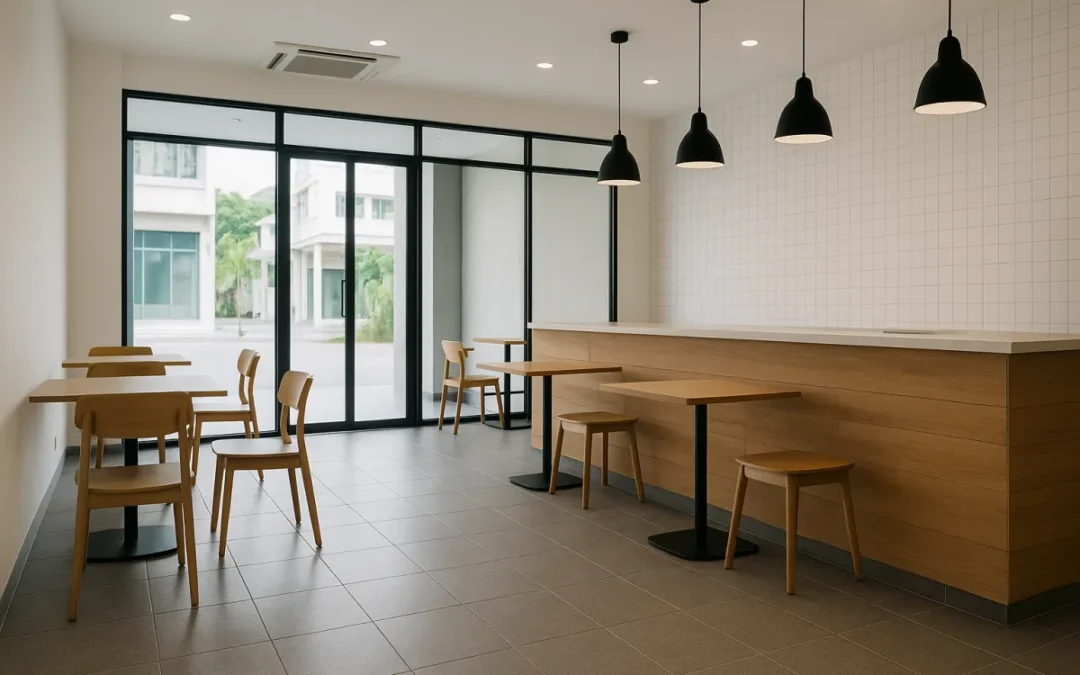
A home floor is walked on by a family. A shop floor is walked on by hundreds of strangers a day, in street shoes, dragging trolleys and dropping things. An office corridor takes the same traffic every day for ten years. Commercial floors fail for one reason: someone specified a residential tile because it looked good in the sample room.
This guide sets out what to specify for a commercial floor in Malaysia, and how the answer changes between a retail shop, an office, a cafe and a back corridor.
Start with homogeneous
For most commercial floors, the default is a homogeneous (full-body porcelain) tile. The colour and material run through the whole tile, so years of wear and the occasional chip never expose a different colour underneath. It is dense, hard and absorbs almost no water. This is why it has been the standard for Malaysian shop lots, offices and public buildings for decades. Our homogeneous tiles guide covers the material in depth.
Glazed porcelain is the alternative where the look matters more than raw wear resistance: a boutique, a showroom, a restaurant dining area. The glaze carries the design, so choose one with a high wear rating and accept that a deep chip will show. Ordinary ceramic has no place on a commercial floor. Our tile types guide compares the three.
The specifications that matter
Wear resistance (PEI rating)
Glazed tiles carry a PEI rating from 1 to 5 for how well the glaze resists abrasion. Residential floors use PEI 3; commercial floors need PEI 4 for moderate traffic and PEI 5 for heavy traffic such as a shop entrance or a mall corridor. Homogeneous tiles have no glaze to wear through, which is the whole point of them.
Slip resistance
Any commercial floor that can get wet, which means every entrance during the monsoon, every cafe, every toilet and every kitchen, needs a slip-resistant surface. Look for an R rating: R10 for general dry-to-occasionally-wet retail and office areas, R11 for entrances, cafes and toilets, R12 or R13 for commercial kitchens and wet back-of-house. A polished tile at a shop entrance is an accident and a liability claim waiting to happen. Our anti-slip tiles guide explains the ratings.
Thickness and breaking strength
Commercial floors take point loads: a trolley wheel, a ladder foot, a pallet corner. Specify a tile of at least 9 to 10 mm, and thicker (12 mm and up) where trolleys and equipment move. Full-bed adhesive with no voids matters more here than anywhere; a void under a tile is where a trolley wheel will crack it.
Water absorption
Under 0.5%, which porcelain and homogeneous tiles meet. Anything higher will stain and hold dirt in a commercial setting.
Stain and chemical resistance
Cafes, salons, clinics and kitchens spill things and clean with strong products. Homogeneous tiles and quality glazed porcelain resist both. Ask for the product’s chemical resistance class if the space will be cleaned with industrial chemicals.
Colour and finish: hide the dirt
A commercial floor cannot be mopped every time someone walks in. The tile has to look acceptable between cleans.
- Mid-tone greys, beiges and speckled “salt and pepper” patterns hide dust, footprints and small marks best. This is why so many Malaysian shop floors are that colour; it is not a lack of imagination.
- Pure white shows every mark and needs constant cleaning. Pure black shows every speck of dust and every scuff.
- Matt hides more than polished and is safer. A polished homogeneous floor is fine in a dry, well-maintained office lobby, and wrong at a shop entrance or in a cafe.
- Texture hides marks and adds grip, but very rough textures trap dirt and are hard to mop. A light structured surface is the balance.
Size, layout and grout
- 600 x 600 mm is the workhorse commercial size: fewer joints than 300 x 300 mm, manageable to lay and to replace one tile later. Larger formats look impressive in a lobby but are harder to replace and more prone to cracking under point loads if the bed is not perfect.
- Keep a few boxes spare. Tiles are made in batches and shades change. A spare box from the same batch is the only way to replace a cracked tile invisibly two years later.
- Grout: use an epoxy grout in cafes, kitchens, toilets and anywhere stains or heavy cleaning are expected; cement grout in a dry office or shop is acceptable. A mid-grey grout hides more than white. Our grout guide covers the choice.
- Movement joints: large commercial floors move with temperature. Flexible joints at the perimeter and across the floor every few metres, and at every change of substrate, prevent tented and cracked tiles. Get them into the drawing, not left to the tiler’s memory.
Space by space
Retail shop
Homogeneous, matt or lightly structured, R10 to R11, mid-tone, 600 x 600 mm. A darker or contrasting band at the entrance hides the worst of the tracked-in dirt.
Office
Corridors, pantries and lobbies in homogeneous; work areas may use carpet or vinyl, but the wet and high-traffic zones should be tile. Polished is acceptable in a dry lobby with good matting at the door.
Cafe and restaurant
Front of house: glazed porcelain or homogeneous with R11, epoxy grout, mid-tone. Kitchen: homogeneous or a dedicated kitchen tile with R12 or higher, coved skirting so the floor-wall junction can be hosed down, and epoxy grout throughout.
Clinic, salon and studio
Homogeneous, smooth matt for easy sanitising, R10, light-to-mid tone to look clean, epoxy grout so chemicals and dyes do not stain the joints.
Corridors, staircases and back of house
Homogeneous, structured surface, R11, mid-tone. Stair treads need a nosing or a step tile with a non-slip edge.
Car park, loading bay and external walkway
Thick homogeneous or outdoor-rated porcelain with an R12 or R13 surface, C2 S1 adhesive and proper falls to drains. See our outdoor tiles guide.
Getting it laid properly
On a commercial floor the installation is half the specification. Insist on a flat screed, a C2-class adhesive with full coverage and back-buttering, movement joints as drawn, and the full curing time before the floor is loaded. Our installation guide covers the sequence, and our adhesive guide explains why sand-cement is not acceptable under porcelain.
See our homogeneous tiles and glazed porcelain collections, or browse by use on our floor tiles page.
Send us the floor plan and tell us what the space is for, and we will put together tile options with the wear and slip ratings the space needs, plus a quantity from the plan.
Frequently asked questions
What is the best tile for a shop floor?
A homogeneous (full-body porcelain) tile, matt or lightly structured, in a mid-tone colour, with an R10 to R11 slip rating. It wears evenly and hides dirt between cleans.
What PEI rating do I need for a commercial floor?
PEI 4 for moderate traffic and PEI 5 for heavy traffic if the tile is glazed. Homogeneous tiles have no glaze and are not PEI-rated in the same way; they are the standard for heavy traffic.
Can I use polished tiles in a shop?
Only in a dry, well-matted area such as an office lobby. At an entrance, in a cafe or anywhere that gets wet, a polished tile is a slip hazard.
What size tile is best for commercial use?
600 x 600 mm is the practical standard: few joints, easy to lay and easy to replace one tile later. Keep spare boxes from the same batch.
Why do commercial floors use grey tiles?
Mid-tone grey and speckled patterns hide dust, footprints and scuffs between cleans better than white or black. It is a practical choice, not a lack of options.