
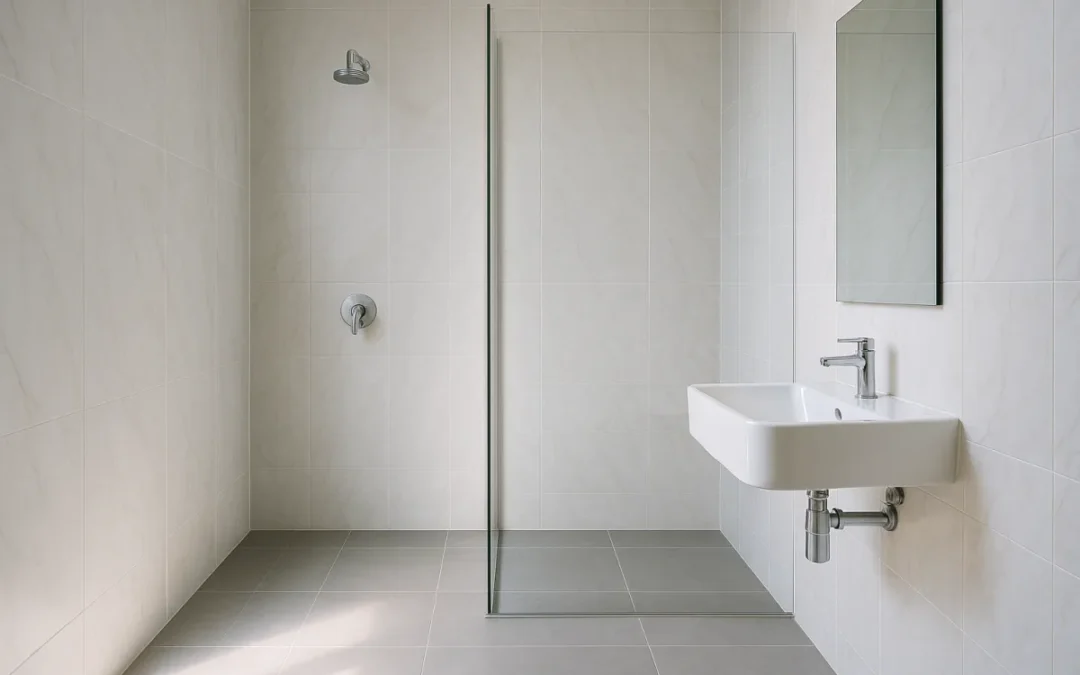
Most tile questions we hear in the showroom are about floors. Walls get less thought, until someone falls in love with a floor tile and asks whether it can go up the bathroom wall, or finds a beautiful glossy tile on the wall display and wants it on the kitchen floor. One of those is fine. The other is a mistake you will pay for.
This guide explains what makes a wall tile a wall tile, when the two can swap, and how to choose wall tiles for the rooms in a Malaysian home.
What makes a wall tile different?
A tile sold as a wall tile is made for a surface that nobody walks on. That changes three things.
- Body. Wall tiles are usually ceramic, with a softer, lighter body than porcelain. Lighter is good on a wall: less weight hanging on the adhesive.
- Glaze. The glaze on a wall tile is chosen for colour, gloss and easy wiping, not for wear. It is often high-gloss, which would be dangerous underfoot but is perfect for a splashback.
- Thickness. Wall tiles are thinner, typically 6 to 9 mm against 9 to 12 mm for a floor tile. Thinner tiles cut more easily and sit flatter on a wall.
Floor tiles, by contrast, are made to carry weight, resist wear and, in wet areas, resist slipping. That means porcelain or homogeneous bodies, thicker sections and matt or textured surfaces. Our guide to tile types goes into the materials.
Can you use floor tiles on walls?
Yes, in most cases. A floor tile is stronger than it needs to be for a wall, so the tile itself is never the problem. The practical points are:
- Weight. Porcelain floor tiles are heavy, and large ones very heavy. The wall must be solid (brick or concrete, not a thin plasterboard partition without backing), and the adhesive must be a proper tile adhesive rated for porcelain, not a cement-sand bed.
- Support while setting. Large heavy tiles will slide down the wall before the adhesive grips. The tiler works from the bottom up with spacers and battens, one row at a time.
- Cutting. Porcelain is hard. Walls have more cuts than floors (around pipes, sockets, niches), so the tiler needs a good wet cutter and a diamond hole saw.
- Finish. Any finish works on a wall. A matt floor tile continued up the shower wall is a clean modern look. A polished floor tile up the wall gives a full marble-bathroom effect.
Running the same tile from the floor up the wall is one of the easiest ways to make a small bathroom feel larger and more expensive.
Can you use wall tiles on floors?
No. This is the one to remember. A ceramic wall tile on a floor will crack under a dropped pot, wear through its glaze in a walkway within a few years, and, if it is glossy, be dangerously slippery the first time the floor is wet. Tile boxes and product sheets normally state whether a tile is for walls only; if the tile is thin, light and high-gloss, treat it as wall only regardless.
The one grey area is a small, low-traffic surface such as a shower niche floor or a step riser, where a wall tile is not walked on. Even there, a matching floor tile is the safer choice.
Choosing wall tiles by room
Bathroom walls
The biggest wall-tile job in most homes. Glazed ceramic or glazed porcelain, in a size that suits the room. Light colours and larger formats make a small bathroom feel bigger. Behind the shower, any tile with a sealed glaze is fine; slip rating matters on the floor, not the wall. See our bathroom tiles page for pairings of wall and floor.
Kitchen backsplash
The wall behind the hob and sink takes oil splatter and steam, so choose a smooth glazed tile that wipes clean. Gloss is practical here. Keep grout lines few (larger tiles) or use an epoxy grout that does not absorb oil; our grout guide explains why. More on kitchen walls and floors on our kitchen tiles page.
Living room feature wall
A TV wall or a dining feature wall in a large-format marble-look or stone-look porcelain has become a common Malaysian choice. These are floor tiles used on a wall, and everything in the section above applies: solid wall, proper adhesive, careful setting.
Wet kitchen and yard walls
Plain glazed ceramic, easy to wipe, in a size that keeps grout lines manageable. Nothing fancy is needed; durability of the glaze against scrubbing is what matters.
Exterior walls and car porch pillars
Use a tile rated for outdoor use, or a brick or stone veneer rather than an indoor wall tile, because sun, rain and heat will lift a tile that was never meant to face them. See our outdoor tiles guide.
Sizes and layouts
- 300 x 600 mm: the most common wall tile size in Malaysia. Laid horizontally it widens a room; laid vertically it raises the ceiling visually.
- 600 x 1200 mm and larger: fewer joints, a seamless look, best in bathrooms with enough uninterrupted wall to show them off.
- Small formats and mosaics: for niches, feature strips and curved surfaces, where a large tile cannot bend.
- Layouts: a straight stack (grid) is the cleanest modern look. A brick bond hides small size variations. Herringbone and chevron suit small areas such as a backsplash where the pattern can be appreciated.
- Grout: match the grout to the tile for a calm wall, or contrast it deliberately to make the layout the feature. Do not fall between the two.
A few practical points
- Wall preparation matters as much as the tile. Render must be flat and dry; any bow shows as lippage on a large tile.
- Waterproof shower walls before tiling. Tile and grout are not waterproof on their own.
- Order extra. Walls have more cuts than floors; 10 to 15% over is normal.
- Plan accessory and fitting positions before tiling, so holes land in the body of a tile and not on grout lines.
Our tile installation guide covers the sequence for both walls and floors.
See the wall tiles collection, and the glazed porcelain range for floor tiles that also work on walls.
Bring a photo of the wall and its measurements and we will show you which of our tiles work on it, and how the wall and floor combine. Ask on WhatsApp or see them in Sungai Buloh.
Frequently asked questions
Can I use floor tiles on a bathroom wall?
Yes. The wall must be solid and the adhesive must be rated for porcelain, and the tiler needs to support large tiles while they set. Running the floor tile up the wall is a popular look.
Can I use wall tiles on a floor?
No. Wall tiles are thinner, softer and often glossy. They crack, wear and become slippery on a floor.
How do I know if a tile is a wall tile?
The product sheet or box will usually say “wall” or “wall only”. If it is thin, light and high-gloss, treat it as wall only.
What is the best wall tile size for a small bathroom?
Larger tiles with fewer grout lines, such as 300 x 600 mm laid vertically or 600 x 1200 mm, make a small bathroom feel bigger. Light colours help too.
Do wall tiles need to be waterproofed?
The wall behind them does. In a shower, a waterproofing membrane goes on before the tiles; the tiles and grout alone will not keep water out of the wall.