
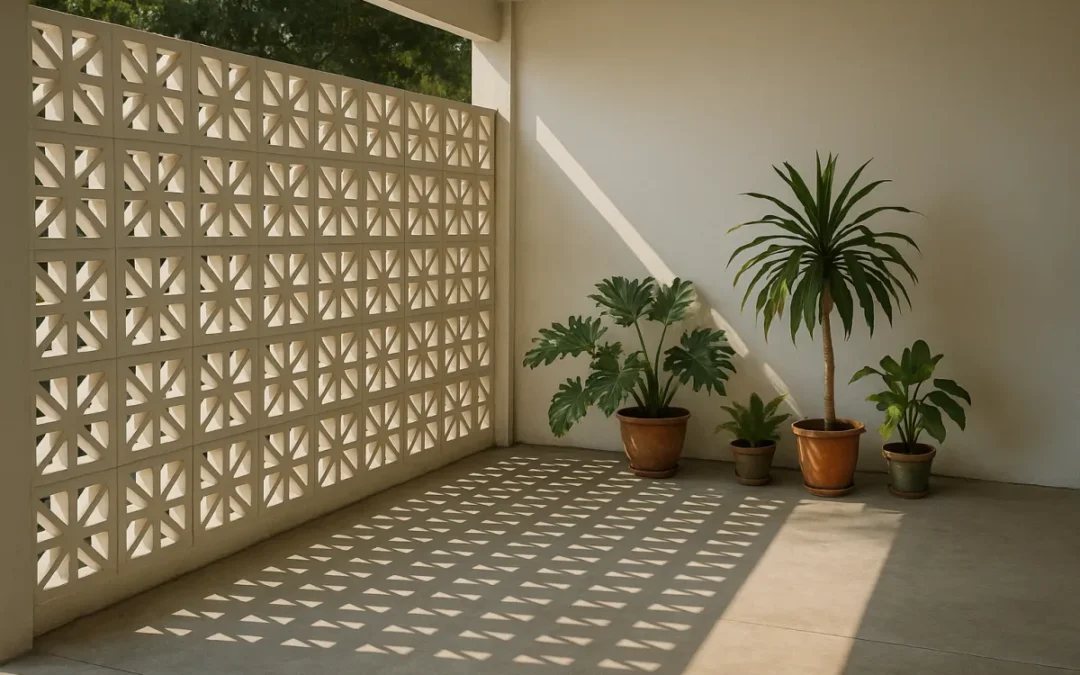
Look at a Malaysian house built in the 1960s or 70s and you will probably find a wall of patterned hollow blocks somewhere: a stairwell, a porch, a boundary wall. Those are breeze blocks, and they were there for a reason that has not changed. The tropics need shade and airflow at the same time, and a breeze block gives both from a single, cheap, permanent material.
They have come back into fashion, this time in cafes, boutique offices and new homes that want the mid-century look. This guide explains what they are, what they do well, where to use them and what to think about before the first block goes in.
What is a breeze block?
A breeze block, also called a ventilation block or vent block, is a hollow block with an open pattern through it. Traditionally they are cast concrete; ceramic and glazed versions exist for a finer finish. They are stacked and mortared like bricks to form a screen wall that light and air pass through.
The patterns range from simple squares and circles to the geometric designs the mid-century era is known for: interlocking crosses, petals, diamonds, wave forms. The pattern is the point. Sunlight through the block throws a moving shadow pattern onto the floor and wall behind, which changes through the day.
Why they suit the Malaysian climate
- Cross-ventilation. A breeze block wall lets air move through a space that a solid wall would seal. In a stairwell, a corridor, a porch or a wet kitchen, that airflow is the difference between a stuffy space and a comfortable one, without a fan.
- Shade without darkness. The block cuts direct sun while still letting daylight in. A west-facing wall behind a breeze block screen is noticeably cooler in the afternoon.
- Privacy that still breathes. From outside, a breeze block screen hides what is behind it; from inside, you still see out and feel the air. That makes it ideal at a boundary, a balcony edge or a bathroom window.
- Rain. Heavy rain does pass through an open pattern, so a breeze block screen is for a space that can get wet (a porch, a yard, an external stair) or is set back under an eave.
- No maintenance to speak of. Concrete blocks in the sun and rain last for decades. Paint them, or leave them raw.
Where to use them
Boundary and fence walls
A full or partial breeze block fence gives privacy from the road without the bunker look of a solid wall, and it lets air into the front yard. Combine a solid lower section with breeze blocks above eye level.
Car porch and side walls
The classic use. A breeze block side wall on a car porch keeps the space shaded and ventilated and stops the porch feeling like a tunnel.
Stairwells and corridors
Internal stairwells in Malaysian terrace houses trap heat. A breeze block wall on the external side lets that heat out and daylight in.
Wet kitchen and yard
Cooking smoke and steam need somewhere to go. A breeze block wall or window infill ventilates the wet kitchen without a mechanical extractor, and screens the yard from the neighbours.
Bathroom windows
A breeze block panel in place of a bathroom window gives permanent ventilation and privacy at the same time. Set it high, and add a fine mesh on the inside if insects are a concern.
Feature walls and room dividers
Indoors, a breeze block screen divides a living and dining area, or a cafe’s seating from its counter, while keeping the space open. Painted white or left in raw concrete, it is a strong architectural feature. The gaps also let air conditioning circulate between the two areas.
Balcony and rooftop screens
On a condominium balcony or a rooftop, a breeze block screen gives shade and privacy while keeping the wind. Check the building’s rules and the load on the slab first.
What to plan before building
- They are not load-bearing. A breeze block wall carries only itself. It needs a proper foundation or beam below and, above a certain height, reinforced concrete stiffeners (columns and a capping beam) so it does not lean or topple in wind. A tall boundary wall in breeze blocks is a structural job for a contractor, not a weekend project.
- Height and stability. Low screens up to about one metre can be free-standing on a good base. Above that, tie them to columns at regular intervals.
- Pattern alignment. Order the exact quantity plus spares from one batch so the pattern lines up and the colour matches. Mixing batches shows.
- Rain and dirt. Open blocks collect dust and rainwater in their recesses. Position them where a hose can reach, and slope the base slightly so water drains out.
- Insects. An open wall is an open wall. Where mosquitoes matter, add a mesh panel on the inside face or use the block only where the space behind is not enclosed.
- Finish. Raw concrete gives the honest mid-century look. Paint gives colour and protects against moss in shaded, damp spots. Glazed ceramic breeze blocks also exist, pre-finished, for a refined interior screen.
- Mortar and pointing. Neat, consistent mortar joints make or break the look. Ask the mason for a sample panel first.
Pairing with other materials
Breeze blocks work best against plain surfaces that let the shadow pattern show: a white rendered wall, a matt grey floor, timber. They pair naturally with the other textured materials in our range, such as brick and stone veneer, on the solid parts of the same wall. On the floor beside an outdoor breeze block screen, use a textured outdoor tile that copes with the rain that comes through; our outdoor tiles guide covers the choice.
See the cement breeze blocks in our range, in several patterns, and the floor tiles and wall tiles that sit alongside them.
Planning a screen wall, a fence or a feature wall? Bring a photo of the spot and its measurements and we will help you choose the pattern and work out the quantity.
Frequently asked questions
What are breeze blocks used for?
Screen walls that let air and light through: boundary fences, car porch walls, stairwells, wet kitchens, bathroom windows, feature walls and room dividers.
Are breeze blocks load-bearing?
No. A breeze block wall carries only its own weight and needs a foundation below and reinforced stiffeners for taller walls.
Do breeze blocks keep rain out?
No. Rain passes through the open pattern. Use them where the space behind can get wet or is sheltered by an eave.
Can breeze blocks be used indoors?
Yes. As a room divider or feature wall they keep a space open while defining zones, and they let air conditioning circulate between areas.
Do breeze blocks let mosquitoes in?
Yes, like any open wall. Fit a mesh panel on the inside where the space behind is enclosed, or use them only on open, external areas.