
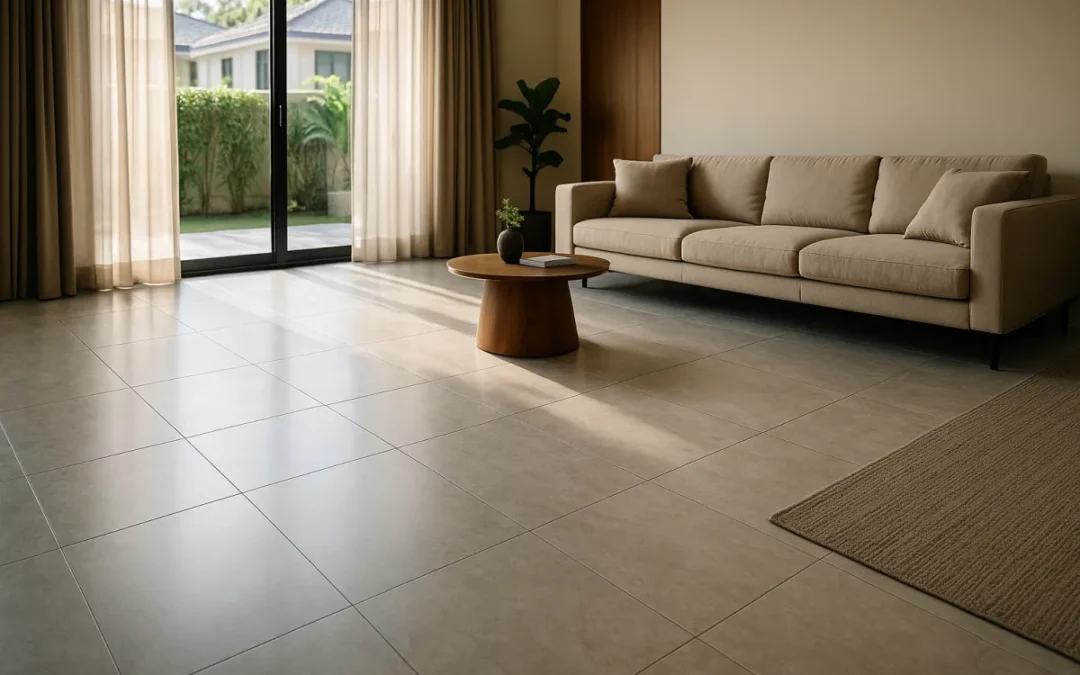
Tile sizes have grown steadily. A generation ago most Malaysian homes had 300 x 300 mm floor tiles. Today 600 x 600 mm is standard, and 600 x 1200 mm, 800 x 800 mm and even larger sizes are common in new homes and renovations. The appeal is easy to see: fewer grout lines, a calmer surface and rooms that look larger.
Large tiles are not the right answer everywhere, though, and they need more care to install. Here is what to know before you choose them.
What counts as large format?
There is no single definition, but in general any tile with one side of 600 mm or more is treated as large format. Common sizes include:
- 600 x 600 mm: the everyday standard for Malaysian floors. Large enough to look modern, small enough to be easy to lay.
- 800 x 800 mm: a step up for bigger living and dining areas.
- 600 x 1200 mm: a popular rectangular format for floors and feature walls.
- 750 x 1500 mm and larger: slab-like tiles, often used for walls, feature areas and commercial spaces.
The advantages
- Fewer grout lines. Less grout to clean and less to stain, and a surface that reads as one piece.
- Rooms look bigger. Fewer joints mean the eye travels further across the floor.
- A premium, calm look. Large marble-look and stone-look porcelain comes closest to real slab stone.
- Continuity. The same large tile can run from the living room to the dining area, and sometimes up a feature wall.
The disadvantages
- The floor must be very flat. A small dip that a 300 mm tile would ride over becomes a rocking tile or an uneven edge with a 1200 mm tile.
- Harder installation. Large tiles are heavy, need two people to handle, and must be fully bedded in adhesive. Labour costs are usually higher.
- More wastage in small rooms. Cutting large tiles to fit small or irregular spaces can waste more material.
- Not ideal on sloped floors. Bathrooms, shower areas and balconies need a fall to a drain. A rigid large tile cannot follow a slope in more than one direction.
- Delivery and handling. Large tiles need careful transport, and access through narrow stairs and lifts can be a problem.
Where large format tiles work best
- Living and dining rooms: the ideal place. Open, flat floors show them at their best. See our floor tiles page for ideas.
- Feature walls: in the living room or behind a bed, a large marble-look tile gives a slab effect.
- Bathroom walls: large wall tiles make a small bathroom feel bigger and are easy to clean. Our wall tiles include larger formats.
- Commercial spaces: shops, showrooms and offices, where large homogeneous tiles combine size with hard wearing.
Where to think twice
- Shower floors: use smaller tiles that follow the fall to the drain and give more grip.
- Small balconies: medium tiles usually handle the fall and the cuts better.
- Very small or irregular rooms: the cuts may leave awkward slivers.
- Old floors that are not level: unless you are prepared to level the base first.
What to ask your tiler
- Will you check and level the floor first? Flatness is the foundation of a good large tile floor.
- Will every tile be fully bedded? Large tiles need adhesive on both the floor and the back of the tile, with no hollow spots.
- Will you use a levelling system? Tile levelling clips keep neighbouring edges flush.
- How will you lay out the tiles? A good layout starts from the centre or a key line of the room so the cut tiles end up at the edges, not in the middle of the floor.
- Offset pattern? Rectangular tiles like 600 x 1200 mm are best offset by no more than a third of their length, not a half, to avoid uneven edges from slight bowing.
How many tiles will you need?
Large tiles make wastage more expensive, so measure carefully and add an allowance for cuts: about 10% for simple rooms and more for rooms with many corners or a diagonal layout. Our tile calculator works out the number of tiles for your room size and tile size.
Large tiles look different in person than on a screen. Work out the quantity first, then see full-size pieces at our Sungai Buloh showroom.
Frequently asked questions
Are large tiles more expensive?
Often per square metre, and installation usually costs more because the work is slower and needs more care. The trade-off is fewer grout lines and a more premium look.
Do large tiles make a small room look bigger?
Usually yes, especially on walls and in a light colour with a matching grout. On the floor of a very small room, a medium size can be the more practical choice.
Is 600 x 600 or 600 x 1200 better for a living room?
Both work. 600 x 600 is easier and more forgiving to install. 600 x 1200 gives a more modern, elongated look and fewer joints, and needs a flatter floor.
Can I use large tiles in the bathroom?
On the walls, yes, and they look great. On the floor, keep them away from the shower area and make sure the fall to the drain is planned.
Why do large tiles sometimes have uneven edges?
Usually because the floor was not flat enough, the tile was not fully bedded, or rectangular tiles were laid with a half offset. A levelling system and a one-third offset help.